

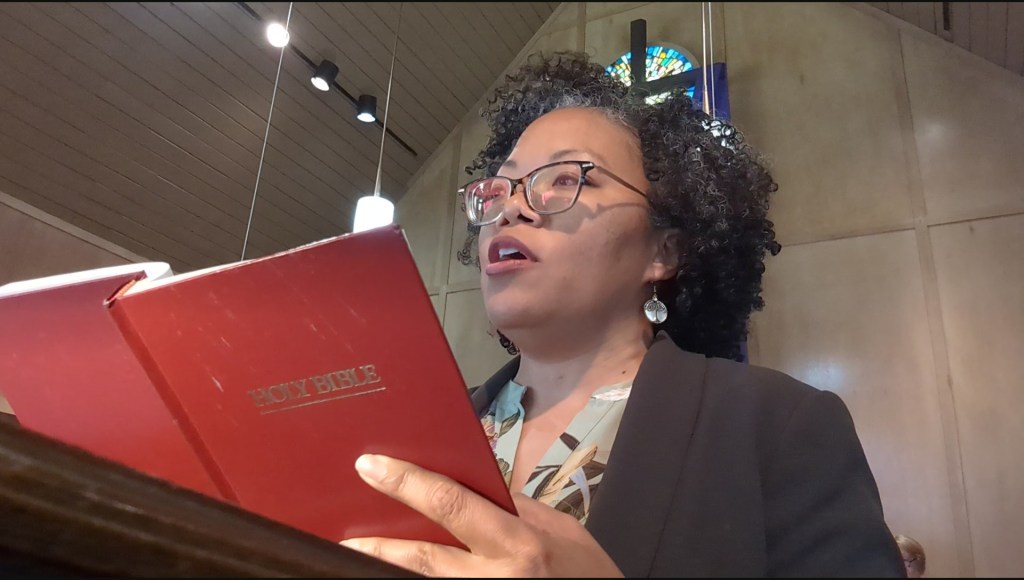
I saw new faces today at the First Presbyterian Church of Clifton! But we collectively felt and experienced the absence of several others not present with us in the body on 23 March 2025. Just the thought of this reminded me of my last sermon preached here in late January titled, “Are you ‘a part’ or ‘apart’ of the body of Christ?” from 1 Cor 12. You can learn more about that sermon here. Today’s sermon text was chosen by me from the Lectionary as the Gospel Scripture for third week of Lent. Together as a church we read, prayed and preached from these chosen Scriptures to join in with other Christians around the world who are also following the lectionary texts especially in this season of Lent, preparing ourselves for the Holy Week and the Easter Season.
As usual, you can scroll down to the end of this blog to watch my after-sermon ‘preaching tips’ video recorded when I got back home. I share about what happened at church today and my preaching tip to go with the flow when delivering your sermon to others. Be attentive to the Holy Spirit at work in the room because whatever is happening can be brought into your sermon on the fly.
I am always hopeful that these offerings would bless and encourage you in your own journey with God and in your ministry of service to others. Feel free to reach out to me or leave a comment below, anytime.
Blessings and peace!
Luke 13:1-9 (NIV)
Now there were some present at that time who told Jesus about the Galileans whose blood Pilate had mixed with their sacrifices. 2 Jesus answered, “Do you think that these Galileans were worse sinners than all the other Galileans because they suffered this way? 3 I tell you, no! But unless you repent, you too will all perish. 4 Or those eighteen who died when the tower in Siloam fell on them—do you think they were more guilty than all the others living in Jerusalem? 5 I tell you, no! But unless you repent, you too will all perish.”
6 Then he told this parable: “A man had a fig tree growing in his vineyard, and he went to look for fruit on it but did not find any. 7 So he said to the man who took care of the vineyard, ‘For three years now I’ve been coming to look for fruit on this fig tree and haven’t found any. Cut it down! Why should it use up the soil?’
8 “‘Sir,’ the man replied, ‘leave it alone for one more year, and I’ll dig around it and fertilize it. 9 If it bears fruit next year, fine! If not, then cut it down.’”
Sermon Summary (according to ChatGPT!)
Your sermon centers on Jesus’ response to suffering, tragedy, and repentance. You draw from Luke 13:1-9, where Jesus is confronted with two events: Pilate’s massacre of Galileans and the collapse of the Tower of Siloam. Instead of addressing the injustices or tragedies directly, Jesus redirects the conversation, challenging the assumption that suffering is a result of being a worse sinner. His focus is on personal repentance—“Unless you repent, you too will perish.”
You bring this into the present, reflecting on unexpected deaths, personal losses, and tragedies that shake us. These moments, rather than prompting us to blame others or question why, should push us to self-examination and repentance.
You then transition into the parable of the barren fig tree, emphasizing God’s patience and grace. The tree (representing Israel and individuals in faith) is given more time, thanks to the gardener’s advocacy (often seen as Jesus). But time is not unlimited—eventually, fruit must be produced.
Key themes include:
1. Personal Responsibility – Instead of focusing on others’ suffering, we should ask, Am I right with God?
2. Urgency of Repentance – Tragedy reminds us that life is unpredictable; repentance must happen now.
3. God’s Grace and Expectation – God gives time and resources for growth, but expects fruit—evidence of transformation in our lives.
4. Interconnectedness – Our repentance and spiritual growth impact not just us but those around us.
You close by emphasizing that Jesus isn’t calling for passive faith but active participation. Repentance isn’t just about avoiding destruction—it’s about becoming fruitful, mature followers who make a tangible difference in the world.
Preaching Tips Background Video
I share about what happened at church today and my preaching tip to go with the flow when delivering your sermon to others. Be attentive to the Holy Spirit at work in the room because whatever is happening can be brought into your sermon on the fly. Consider naming what’s happening in the moment because actually there may be something that needs to be said. Specifically, key leaders were not present at today’s church worship service and this reminded me of my previous sermon at this church, when I preached about the body made up of many parts, which are all needed. That sermon is here.
You can find the rest of my sermons here! https://sejanashines.com/preaching


Share your comment